Modified citrus pectin (MCP) is citrus pectin processed into shorter, lower-molecular-weight chains. Regular food pectin is commonly selected for gelling, thickening and stabilization. The right choice depends on the function you need: a reliable food gel, a stable texture or a defined low-molecular-weight ingredient. Low-methoxyl pectin and MCP are not interchangeable terms, because esterification and molecular size describe different properties.
| Key difference | Regular food pectin | Alpha’s listed MCP grade |
|---|---|---|
| Main selection focus | Gelling, thickening or stabilization | Defined low-molecular-weight citrus pectin |
| Molecular weight | Varies by raw material, processing and grade | Specified 5,000-22,000 Da (5-22 kDa) |
| Esterification | Includes distinct HM and LM grades | Specified DE 2-33% |
| Galacturonic acid | Check the chosen grade and assay basis | Specified ≥65% |
| Substitution | Select for the required food function | Not an assumed one-for-one replacement for a gelling grade |
General food-pectin characteristics [1, 2]; Alpha’s listed MCP specifications [4]. MCP values are grade-specific.
What regular pectin does in food
Pectin is a family of plant polysaccharides with galacturonic-acid-rich regions. Commercial food pectin commonly comes from citrus peel or apple pomace. Its structure and processing affect viscosity and gel strength, so “regular pectin” covers a range of grades rather than one uniform ingredient. [1]
High-methoxyl (HM) pectin typically forms gels in acidic, high-soluble-solids systems. Low-methoxyl (LM) pectin can form calcium-mediated gels without requiring the same high sugar concentration. This makes the HM or LM distinction an important starting point when developing fruit preparations, spreads and other gelled foods. Some food pectins are also amidated, adding another structural variable to consider. [1, 2]
What changes in modified citrus pectin
MCP processing breaks longer citrus-pectin chains into smaller fragments. Alpha’s listed MCP grade is made from citrus peel using enzymatic processing and hydrolysis, and is specified at 5,000-22,000 Da (5-22 kDa), with a degree of esterification of 2-33% and galacturonic acid of at least 65%. These parameters describe that grade, not every ingredient sold as MCP. [4]
Alpha’s galacturonic-acid specification of ≥65% is an acceptance limit, not a statement that every lot contains exactly 65%. Confirm the assay method and calculation basis before comparing percentages from different documents. A specification defines what is acceptable; a lot-specific certificate of analysis (COA) reports the batch outcome. [4]
The processing route matters. A primary experimental study of chemically modified citrus pectins found changes in molar mass with relatively little change in degree of esterification. Molecular size and esterification should therefore be evaluated separately, rather than inferred from the word “modified.” [3]
Why low methoxyl pectin is not the same as MCP
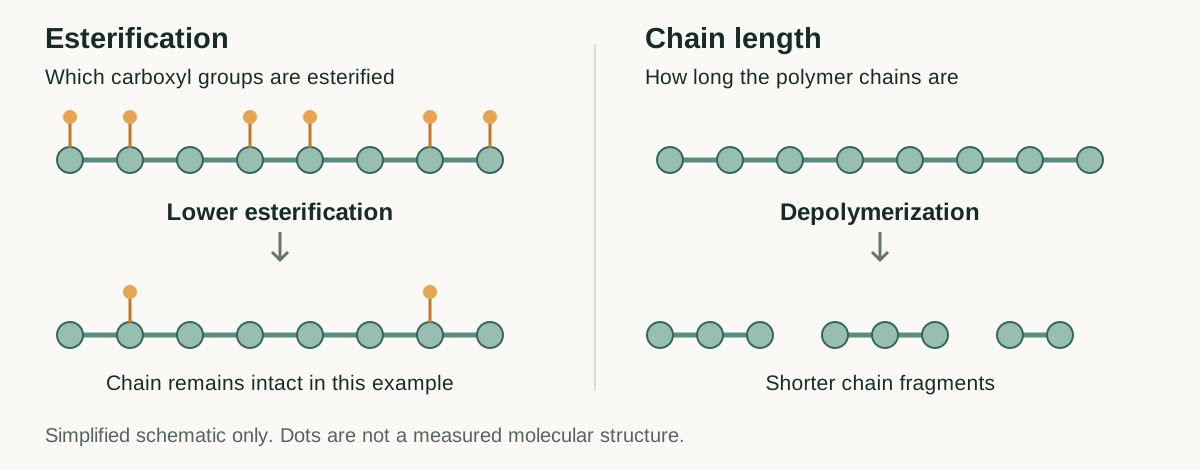
Degree of esterification (DE) describes the proportion of galacturonic-acid carboxyl groups that are esterified. Conventional HM grades have more than 50% methyl esterification; LM grades have less than 50%. A methoxyl-content percentage by mass is a different measurement and should not be substituted for DE. [1]
An LM food pectin can retain long chains and useful gelling properties. Lowering DE changes the availability of carboxyl groups; depolymerization breaks the polymer backbone into shorter chains. A low DE does not, by itself, identify a low-molecular-weight MCP. For buyers, “LM pectin” answers a different question from “MCP with a specified molecular-weight profile.”
How to choose pectin for your formulation
For jams and gelled foods
Start with a food-pectin grade designed for the required texture. Match HM or LM behavior to the formula’s soluble solids, acidity and calcium availability, then evaluate gel strength, setting time and water release under the actual processing conditions. A low-sugar recipe and a traditional high-solids jam may need different pectin grades. [2]
Do not replace a gelling pectin with MCP on a one-for-one basis without reformulation trials. Shortening the chains can change rheology and gel behavior; the primary modification study reported weaker gels under its test conditions. That is a reason to test the intended material, not a basis for claiming that every MCP is incapable of forming a gel. [3]
For beverages and drink powders
Define what the pectin is meant to do before choosing a grade. A beverage may need body or stabilization, while a drink powder may require a particular MCP composition. These are different formulation targets. Test dispersion, hydration, mouthfeel and stability in the complete formula, including its acids, minerals and other ingredients.
“Water soluble” does not guarantee instant dissolution, a clear drink or stability throughout shelf life. Ask for viscosity data at a stated concentration, temperature and test method, then compare those data with your own processing conditions. A result measured in water should not be treated as a finished-beverage performance guarantee.
For MCP blends and supplement concepts
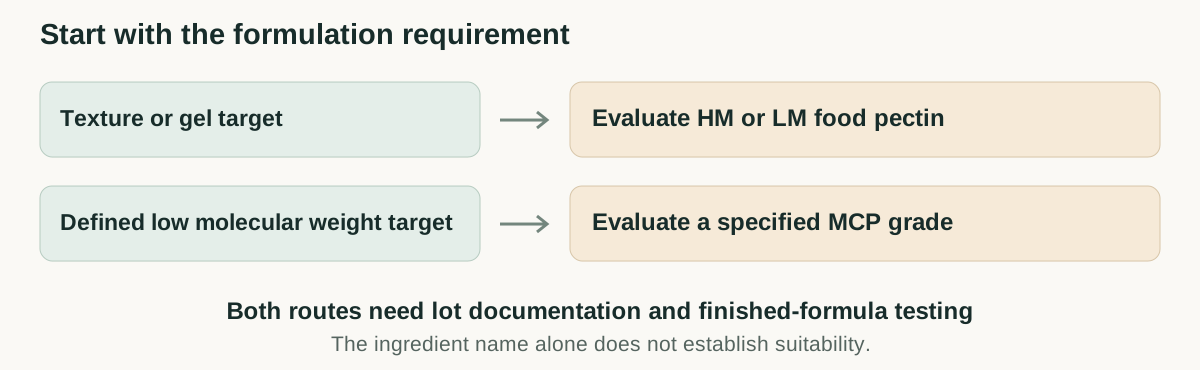
Start with the molecular profile and composition required for the project. Check that the selected grade, ingredient concentration and proposed use fit the development brief. If a concept draws on published research, compare the studied material with the ingredient being purchased; a shared name or a similar headline specification does not establish equivalence.
When comparing quotations, compare the specification and intended use as well as price per kilogram. A pectin selected for gel performance and an MCP selected for a molecular profile are not equivalent purchases. Set the acceptance criteria first, then use the documents and sample trial to judge whether a candidate meets them.
A smaller molecular size is not proof of better absorption or a clinical benefit. Those claims need separate evidence for a suitably characterized material and intended use. Treat molecular-weight data as ingredient characterization, not a substitute for human evidence.
What to check before buying bulk MCP
A COA may give a measured value or a pass/fail entry. In an example batch inspection report for this MCP grade, molecular weight and DE are recorded as meeting their specified ranges. Those entries are not a full molecular distribution or an exact DE measurement. [5]
- Confirm the molecular-weight method and what the reported value means: a number-average, a weight-average or a defined distribution interval. Request the supporting profile when size distribution matters. [6]
- Review DE, galacturonic-acid assay basis and full composition alongside moisture, relevant contaminant limits and microbiological results.
- Test a sample at the intended concentration and processing conditions, and assess performance and stability in the finished formula.
- Check that the documents apply to the grade and lot being purchased, and review suitability and proposed claims for the destination market.
Frequently asked questions
Is all citrus pectin modified citrus pectin
No. “Citrus” identifies the source material. MCP additionally describes processing that reduces molecular size. Conventional citrus pectin can be sold in different food-functional grades without matching a particular MCP specification.
Is modified citrus pectin better than regular pectin
Neither is universally better. Choose a validated food-pectin grade for the required texture, or evaluate a defined MCP grade when the project needs a lower molecular weight. Suitability depends on the actual formula and specification.
Can low methoxyl pectin replace MCP
Not on the basis of DE alone. Low esterification does not establish short chains or the molecular-weight profile of an MCP grade. Compare molecular size, composition and formulation behavior before considering a substitution.
Does the 5 to 22 kDa range describe every MCP
No. It is the specification for Alpha’s listed grade. It should not be generalized to all MCP, rewritten as an average or taken to mean every molecule falls within that interval without an analytical definition. [4, 6]
Choose by function and verify by specification
Regular pectin and MCP can share a citrus origin while serving different formulation needs. Keep chain length separate from esterification, match the grade to the intended function, and confirm performance with the actual sample.
Explore Alpha’s modified citrus pectin specification to review the grade and discuss your intended format and technical requirements. For more on interpreting research, read our MCP and heavy-metals research review.
References
- EFSA ANS Panel. Re-evaluation of pectin and amidated pectin as food additives. EFSA Journal. 2017;15(7):4866. Read source
- FAO. Selecting products and production methods. Section 2.2.5, pectin and papain. Read source
- Fracasso AF et al. Chemical modification of citrus pectin. International Journal of Biological Macromolecules. 2018;109:784-792. Read source
- MCP technical specification, pages 1-3; checked against Alpha’s published product specification. Grade-specific parameters. Read source
- MCP batch inspection report, page 1. Illustrative lot documentation, not independent verification.
- IUPAC Gold Book. Molar-mass average. Read source